

The Arthritis Society of Iceland
- 530 3600
- Brekkuhúsum 1
- gigt@gigt.is
- Monday - Thursday: 9:00 - 15:00
- 530 3600
- Brekkuhúsum 1
- gigt@gigt.is
- Monday - Thursday: 9:00 - 15:00
Gout
Gout

What is gout?
Gout is an inflammatory arthritis that can cause painful inflammation in the joints. It most often affects the big toe, but can affect any joint in the body.
Most foods contain a substance called purine. In the body, this is converted into uric acid, which is then cleared by the kidneys. If too much uric acid builds up in the body, crystals can form and deposit in and around the joints. The crystals can remain there for a long time without a person being aware of them. Sometimes, a knock to a joint, a high temperature or stress on a joint can dislodge the crystals, causing the joint to become swollen and painful.
Who gets gout?
Gout is the most common type of arthritic disease and about 4% are diagnosed at some point in their lives. It is 3-10 times more common in men than in women and the risk of the disease increases with age.
Gout is a metabolic disorder and is not solely related to lifestyle. However, the risk increases with higher levels of uric acid in the blood.
The following factors affect the level of uric acid in the blood:
- Excessive alcohol consumption causes an accumulation, especially of beer.
- Diet – high consumption of purine-rich foods (e.g. red meat and shellfish).
- Medicines, such as diuretics, can cause accumulation.
- Diseases where a large number of cells are broken down, such as in psoriasis and some blood disorders.
- Obesity.
- High blood pressure.
- Kidney failure.
- Diabetes.
- Genetic factors that affect production or how the kidneys excrete uric acid.
What are the symptoms of gout?
- Gouty arthritis occurs in recurring attacks and starts very suddenly (within a few hours). The attacks often begin at night, and the pain is worst during the first 24 hours.
- Sudden swelling of a single joint, most often the big toe, but can occur anywhere in the body.
- The team will be hot, red, swollen and very sore.
- Reduced mobility due to pain.
- The episodes can last for several days or weeks, but they usually pass within five to seven days.
- Skin nodules – If gout is left untreated, uric acid crystals can accumulate in the skin (called tophi), forming painless, small, white lumps. Crystal deposits form on the tops of the fingers and toes, the backs of the heels, around the elbows and on the ears.
Usually, there are no symptoms of gout except during attacks, but uric acid crystals accumulate in the body both during and between attacks.
When should you see a doctor?
- you suddenly get a lot of pain in a joint.
- You have a swollen, red and sore joint.
- You get repeated throws.
- experiences persistent pain or stiffness.
If you have these symptoms and they persist without treatment, it is advisable to consult a doctor for diagnosis and treatment. The same applies if you have a diagnosis but the treatment is not working. Untreated gout can lead to joint damage due to the inflammatory response.
How is the diagnosis made?
A doctor bases the diagnosis on typical symptoms, an examination of the joints and a measurement of uric acid in the blood. The amount of uric acid in the body can be easily measured with a blood test, and this allows the success of treatment to be assessed.
If the diagnosis is unclear, it is possible to take certain scans (Dual-energy CT) which detect crystal deposits in the body.
If a blood test is taken during an attack, it does not always show an accurate result, as the uric acid level in the blood is lower at that time. It is best to have a blood test taken a few days after the attack has passed.
Blood tests can also show that some healthy individuals, particularly close relatives of people with gout, can have high levels of uric acid in their bodies for years or even their entire lives, without being aware of it and without experiencing a gout attack.
What is the treatment for gout?
Medicine for acute attacks:
- Anti-inflammatory medicines often help with acute attacks, such as ibuprofen, naproxen and Celebrex.
- Colchicine can be used if you cannot tolerate anti-inflammatory drugs.
- Steroids in tablet form or injected into the joint are also a treatment for an acute attack.
The aim of long-term treatment is to prevent seizures.
- Prophylactic medication: Allopurinol lowers blood uric acid and prevents recurrent attacks. If allopurinol is not tolerated, febuxostat can be used.
- Dietary changes: It is important to reduce the consumption of purine-rich foods, e.g. red meat and shellfish, and to reduce the consumption of sugary drinks.
- Increased water intake: Helps the body to flush out uric acid and reduces the risk of kidney stones. Weight management: Maintaining a healthy body weight can reduce the frequency of attacks.
- Avoid alcohol, especially beer, which can increase the amount of uric acid in the blood.
What can people with gout do?
Regular medication and a healthy lifestyle are key to preventing seizures.
- Follow the treatment plan from the doctor.
- Regular exercise.
- A healthy diet, limit purine-rich foods such as red meat and shellfish.
- Drink enough water.
- Avoid sugary drinks and especially alcohol.
- Rest the affected limbs during a gout attack and use cooling to reduce pain.
What are the prospects?
The outlook is generally good with proper treatment, which can keep the disease under control and prevent recurrent attacks.
Regular follow-up and treatment are very important to prevent permanent joint damage and maintain a good quality of life.
Further material

The Arthritis Society Summer Raffle 2026 Winners' List
7 September 2026
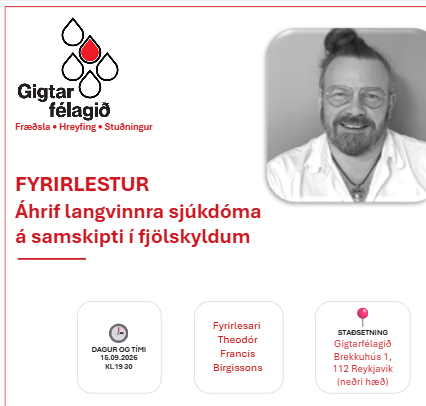
Lecture – The impact of chronic illnesses on family communication
1 September 2026

Chair exercises – New
25 August 2026