Jóna Guðbjörg Árnadóttir
Today summer has arrived, at least according to the calendar; the sun is steadily rising and the number of sunny hours is increasing, or whenever the weather gods allow. It is common knowledge that the sun has an effect on our daily lives and our health.
As the sun rises, people not only notice more beautiful and fresher skin, but their strength and stamina generally increase as well.
The sun causes the body to produce vitamin D, which is essential for bone development, but there is also evidence that vitamin D can reduce mortality. The body's production of vitamin D is triggered by ultraviolet rays from the sun.
But what are ultraviolet rays?
Ultraviolet rays are solar rays known as UV. UVA and UVB are waves that reach the Earth and can cause damage to unprotected skin. The intensity of UV radiation depends on the season, the time of day and the weather. The sun is strongest in summer around midday, so it can be important to protect yourself from the sun's rays and even avoid being outdoors between 11 am and 3 pm, especially when the sun is strong.
Is there a difference between UVA and UVB?
Yes. UVB are short wavelengths that can cause sunburn and cancer. Everyone is familiar with sunscreens labelled with an SPF value. SPF refers to the level of protection the sunscreen provides against these UVB rays. Sun cream with an SPF of 15 blocks about 92% of the sun's rays, SPF 30 blocks over 96%, and SPF 50 blocks over 98%. However, UVA rays are generally less well known. They are long waves that penetrate deep into the skin and cause ageing. They can cause skin discolouration and cancer. UVA rays pass through glass, so it can be very important to protect yourself even when indoors. It should be noted that UVA rays also pass through clouds and fog.
Most, if not all, people know that the sun can be harmful and cause sunburn, but those of us with lupus need to be particularly careful and even avoid the sun.
Lupus, or systemic lupus erythematosus, is an autoimmune disease where the body's immune system is overactive; it is overactive…
How so?
The body's immune system is a defence mechanism where cells are supposed to destroy infected cells that have been attacked by, for example, germs or bacteria. What happens in autoimmune disease is that instead of destroying only infected cells, the immune system starts to destroy healthy cells and organs such as those in the skin, joints, kidneys, cardiovascular system or nervous system. Most people know that sunbathing gives many people a beautiful tan and a fresher look. The same thing happens for many with lupus, but others get a redness in the skin like a sunburn or red patches with a rash that can be extremely difficult to get rid of. One of the main features of the disease is a red rash across the cheeks and nose that resembles the spread of butterfly wings.
When most people sunbathe to get a nice tan, the body's immune system attacks the damaged cells.
The disease lupus causes the immune system to attack not only damaged cells but also healthy cells. That is why it is so important for us to protect ourselves from the sun, even if we do not see or feel any reaction in our skin.
This is called photosensitivity and can vary greatly from patient to patient. Some experience immediate skin discomfort or get pains such as joint aches and fatigue, but others feel nothing at all. What is not widely known is that symptoms can appear many weeks or even months after a person has been in the sun. The reason one of the main treatments for lupus is to avoid the sun is that the immune system can cause damage to organs, as has been shown.
People with lupus do not have a sun allergy; rather, the sun triggers an allergic reaction in the body. Because the symptoms appear so late, patients often do not realise that sunbathing causes these symptoms, which are called lupus flares. However, they are very common in autumn and early winter. The younger a person is when they experience symptoms of lupus, the more sensitive they are to sunlight.
How can I defend myself then?
Standard equipment for people with lupus should be sun cream, clothing with sun protection, known as UPF, hats and sunglasses because although it is important to avoid sunbathing, life is just such that it is not always possible to avoid the sun. You should use sunglasses with UV400 protection or a CE mark, and hats with wide brims. In this country, there is not a wide selection of sun-protective clothing, but you can use dark clothes made from very tightly woven cotton, polyester or nylon, which can work just as well as clothing with UPF protection. The rule of thumb is that if you hold the garment up to the light and you cannot see through it, it should provide good protection.
But isn't it hot being in dark clothes?
Yes, that can be the case, but if the clothes are loose, air is trapped between the skin and the fabric, letting in cooler air and thereby cooling the body. It's worth bearing in mind that if clothes are tight, the material stretches and lets more UV rays through, and this doesn't create enough air between the fabric and the skin to cool the body down. The day should be started by applying face cream and then sun cream.
But can I use just any sun cream?
No. The quality of sunscreens varies greatly, and it is extremely important to us to ensure that the sunscreen we use has an SPF of at least 50+. As has been noted, a sunscreen with SPF 50 blocks about 98% of the sun's rays, but only if a sufficient amount is applied.
It is a good idea to apply the sun cream between your index and middle fingers, as this is a sufficient amount for your face and neck.
Research shows that the vast majority of people use far too little sunscreen, which consequently does not provide as much protection as it should. Remember, more is better! The sun cream needs to have a UVA symbol with a circle around it, as this is the sign for UVA rays. Sun cream that offers both UVB and UVA protection is often labelled 'Broad Spectrum' and is essential for us wolves.
But what does PA+ or PA++++ mean?
PA with + is a symbol for protection against UVA rays produced in Asia. The more + symbols, the better the protection. This means that people with lupus need to choose a product with SPF50+, UVA protection marked with a circle or PA+++ or PA++++; it is also best to have water protection.
Isn't it enough to just put on plenty of sun cream in the morning when it's sunny?
No, unfortunately, it's not quite that simple. It's important to bear in mind that even if you don't intend to be outside except in the shade, UV rays can be reflected by light surfaces such as paving or walls, and they are highly reflective from water and snow.
Don't forget that when we sit by a window, it's like being outside, because UV rays pass through glass, as well as through clouds and fog.
Whether it is sunny or not, people with lupus should always apply sun cream to their face, neck and the backs of their hands. It is a good rule to apply it 20 minutes before going outside, as some sun creams need time to be absorbed into the skin and for the active ingredients to start working. It should then be reapplied every four hours during the day, or every two hours when outdoors, to all areas exposed to sunlight. Those who prefer to wear make-up can apply it over the sunscreen, which has been allowed to fully absorb into the skin, for an extra layer of protection.
Just as we wash off our make-up at the end of the day, it's a good idea to remove your sun cream, especially waterproof ones, as they can contain irritating substances. Hopefully, all wolves can now go out into the summer safely and enjoy themselves with family and friends.
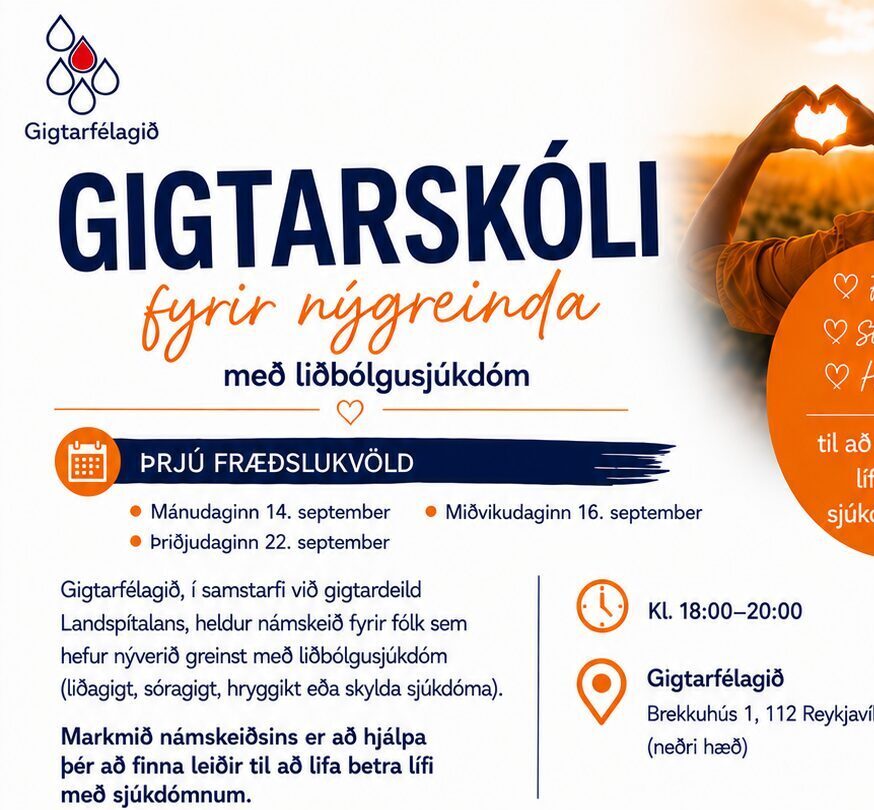
Today, 10th May, is World Lupus Day, and further information and education are available from the Arthritis Society of Iceland. The Arthritis Association is holding an open house between 1 pm and 3 pm on Saturday, 17th May at Brekkuhús 1, 112 Reykjavík.
The author is a sports scientist at the Arthritis Association of Iceland with a master's degree in health training and teaching from the University of Reykjavík.
Sources:
Chavda, V. P., Acharya, D., Hala, V., Daware, S., & Vora, L. K. (2023). Sunscreens: A comprehensive review with the application of nanotechnology. Journal of Drug Delivery Science and Technology, 86, Article 104720. https://doi.org/10.1016/j.jddst.2023.104720
The Office of the Chief Medical Officer (n.d.). Vitamin D. Retrieved 28 April 2025 from https://island.is/d-vitamin
Rheumatism Association of Iceland (n.d.). Red Wolves. Retrieved 28 April 2025 from https://www.gigt.is/raudir-ulfar/
Heilsuvera (2024). Are you sun-kissed?. Retrieved 5 May 2025 from https://www.heilsuvera.is/efnisflokkar/fyrirbyggjandi/orugg-i-solinni/ertu-solklar/
Keyes, E., Werth, V. P., and Brod, B. (2019). Potential allergenicity of commonly sold high SPF broad-spectrum sunscreens in the United States: From the perspective of patients with autoimmune skin disease. International Journal of Women's Dermatology, 5(4), 227–232. https://doi.org/10.1016/j.ijwd.2019.05.006
Cancer Research (n.d.). Sun and ultraviolet rays. Retrieved 28 April 2025 from https://www.krabb.is/forvarnir/solarvarnir/sol-og-utfjolublair-geislar
Lupus UK (n.d.). What is Lupus?. Retrieved 28 April 2025 from https://lupusuk.org.uk/what-is-lupus/
Lupus Europe (n.d.). The 100 Questions. Retrieved 5 May 2025 from https://lupus100.org/en/100-questions
Lupus Group of the Rheumatism Association of Iceland (2022). Red Wolves. Retrieved 5 May 2025 from https://lupushopur.wixsite.com/lupushopur/blog/categories/rau%C3%B0ir-%C3%BAlfar
Siswanto, Q., Qulub, F., & Junico, V. O. V. (2025). Nanoparticle formulation of ZnO:TiO₂ as a sunscreen cream for patients with Cutaneous Lupus Erythematosus (CLE). Journal of Physics: Conference Series, 2945(1), 012019. https://doi.org/10.1088/1742-6596/2945/1/012019
Rothfield, N., Sontheimer, R. D., & Bernstein, M. (2006). Lupus erythematosus: Systemic and cutaneous manifestations. Clinics in Dermatology, 24(5), 348–362. https://doi.org/10.1016/j.clindermatol.2006.07.014
Ting, W. W., & Sontheimer, R. D. (2001). Local therapy for cutaneous and systemic lupus erythematosus: Practical and theoretical considerations. Lupus, 10(3), 171–184. https://doi.org/10.1191/096120301667674688
Wang, S. Q., Balagula, Y., & Osterwalder, U. (2010). Photoprotection: A review of the current and future technologies. Dermatologic Therapy, 23(1), 31–47. https://doi.org/10.1111/j.1529-8019.2009.01289.x